
Eco-Oysters™
Never leave a bay unclean.

News Articles About Oysters
NEWS FLASH 1
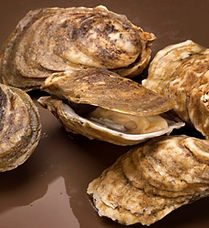
The impact that oysters have on today's ecosystems are behemoth. One oyster alone can filter 1.3 gallons an hour. With multiple oysters the result can be huge. If one oyster can filter 2-60 liter bottles a day, imagine how our products can help the oceans. The way oysters filter this water is by pumping the water through the its cilia. “Plankton, algae and other particles become trapped in the mucus of the gills.” (BayBackPack.com) After the particles are expelled out of the water, the now clean water comes out of the anus. The oysters have similar values that we would like to have in our final product. As you can see, if this product can filter as much, or more water as an oyster, then this product can help clean up oceans, ponds, and lakes.

NEWS FLASH 2
Oysters are filter feeders, meaning they eat by pumping large volumes of water through their body. Water is pumped over the oyster’s gills through the beating of cilia. Plankton, algae and other particles become trapped in the mucus of the gills. From there, these particles are transported to the oyster esophagus and stomach to be digested. Other materials, like chemicals and pollutants, can also be filtered. “We see initial applications in Korea, but conceivably this could be applied anywhere in the world where you have intense mariculture,” said Ben Koopman, a UF environmental engineering professor. But even though they can filter chemicals and pollutants, this is dangerous to the oyster population, and the human population because we eat the chemicals trapped in the oysters.
http://blog.baybackpack.com/?p=1657http://news.ufl.edu/2004/06/30/oyster-tip/

NEWS FLASH 3
Article 1 is about an oyster farm in New England. It is talking about how the farmers have to compete with the weather of New England. It also talks about how climate change will affect the oyster farms and their oysters. This also means that climate change will also affect wild oysters. The article also talks about how oysters were eaten thousands of years ago by our ancestors. Even Native Americans ate oysters. There is also a part about preserving the oysters in the wild. It states, “Natural oyster populations remain at just 1 percent of historical levels.”.
Dec 12, 2023
Interview with Expert Leighton Morrison, Biological Entrepreneur
Q: What do you do for a living? What is your profession?
A: “At this point in my life I am creating biological soil amendments.”
Q:What interests you about your profession?
A: “It’s actually the beginnings of life. It’s on a biological level so all life comes from it. and also it could help save the earth from the pressures of humanity.”
Q: How does what you do relate to our project?
A: “The oysters are a part of aquaculture. They are the filters for all fresh which enters into the salt water. So they live in a brackish environment so they’re very critical to nature. In letting nature continue to produce seafood which we all eat.”
Q: How bad is the decrease in oyster population situation?
A: “It’s pretty drastic. The shellfish of all kinds, all the mollusks have died off at huge rates due to the influx of nitrates and phosphates from commercial fertilizers. It has been documented very well and if you read any newspapers about Long Island last year they had a terrible sea food industry year. They had both brown and red tides which they kill the shellfish that actually clean the water for the ocean. It is a big problem.”
Q: Do you think the decreasing oyster population is a situation that should be addressed?
A: “Yeah I think it should be like a national defense. If you want to feed your populous and take care of your people you need clean water and you need access to healthy sea food. For them to die off and be such a big part of our ability to feed ourselves is a real problem.”
Q: If the decrease in oyster population is not addressed what should people expect?
A: “Higher prices and lack of quality in seafood. In order for the oysters and mollusks to do their job correctly they need to be very abundant and when you start to kill off the population and only the very strong survive you have a very sparse population so therefore everything becomes tougher, less tasty, and less healthy because it is being over nutrified and it’s trying too hard to keep the water clean around it so it becomes stressed out so no longer is that sea food of great value.”
Q: What do you know about the oyster filtration system?
A: “It is the most amazing filtration on the planet. It is purely biological, it goes all the way down to the micron scale. Microns are very small and particular. It is very complicated.”
Q: What do you think our product should look like? If you were to do this project how would you set up an experiment?
A: “Well I already like how you started with the filtration system of gravel, course sand and fine sand. That is a natural filter. If you look at all the waters that come off of mountains what do they look like? Pools of rocks, sand, big rocks, small rocks and fine sand, which also houses all the bacteria that helps to purify and oxygenate the water.”
Q: How can we improve our experiment to make it more effective? How can we make it more like an oyster?
A: “There are a lot of studies being done on 3D farming and that is where I would direct you. 3D aquaculture is where your growing all different levels in what we call the water column so you’re growing kelp on the bottom, oysters suspended and then perhaps some crayfish or shrimp so that you have almost a microcosm to allow one life form to help take care of another life form so you aren’t just getting one thing, you’re getting 3 things.”
Q: Who do you think would buy our filter? Would you buy it?
A: “If you are successful and create an ergonomic, economical, filtration system that would filter the water for perhaps the mollusks so you increase their population or even on a personal scale I think you would have something that would be really great in a lot of ways.”
Q:Do you know of anyone who has done a project similar to ours?
A: “Yes, a lot of colleges are doing this and you would be amazed how simple some of their experiments are and based on what you’re already talked about by using the minerals as a filtration system you are doing what is called biomimicry. Biomimicry is to mimic or copy a system that works in nature. now we know that the rain falls in the mountains comes down the creeks and the creeks naturally filter the water. When the water gets out of the mountain and gets into the slow moving river it’s the cleanest it will ever get and it’s highly loaded with minerals and dissolved oxygen which are the critical forms for biology to happen and for life, good quality of life to occur.”
Q: Do you have any suggestions for our project?
A: “Use gravity to help force the water through the filtration system, perhaps modifying the screens with some modern technology and keep it simple.”